

Three generations of the Bayly family have shaped this land by hand, and after everything, David and Geraldine can’t think of a single thing they’d do differently.
The family story starts in 1953, when David’s grandfather bought two hundred acres of scrub, about as unpromising a start as land gets.
His father, Don, turned it into farmland through the 1960s. David grew up on the farm, and coming from a family of gardeners, it wasn’t surprising he chose horticulture over farming as a career. He studied it, worked in commercial horticulture for several years, and then headed to the UK.
While in the UK, he noticed something New Zealand didn’t really have: you could drive along almost any road, stop at a garden, and walk in.
“I realised that in New Zealand you couldn’t really do that,” he says. “And so I’d always sort of had the idea that we would open our gardens to the public.”
When he returned to New Zealand, David took over part of the family farm, planted the gardens, and set up the Plant Centre and Plant Nursery alongside them.
It took fourteen years before they were ready to open to the public.
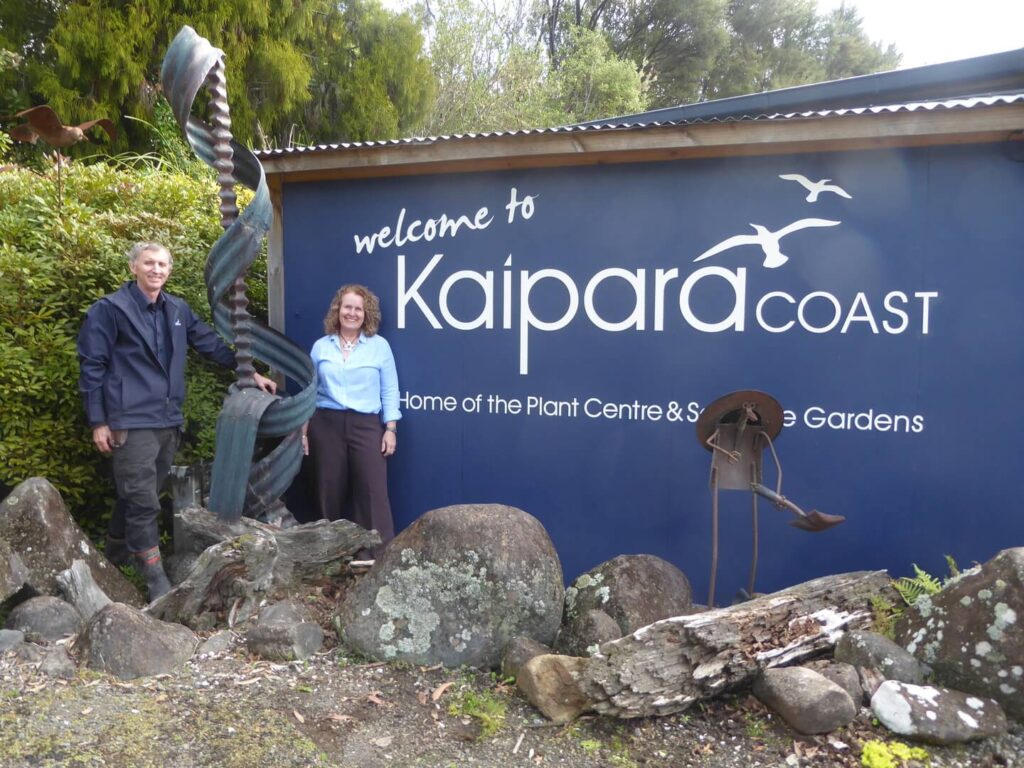
The sculpture trail that Kaipara Coast is now known for happened almost by accident, out of a job interview that had nothing to do with art.
“I was interviewing a local lady called Sally Lush for an office position,” David says. “Very shortly after we started talking about the office position, we started talking about sculptures and sculpture trails, and Sally said, ‘Oh, you should do one here.’”
They never hired Sally for the office job.
Instead, they offered her something else: curator of an entirely new sculpture trail. That was late 2007. By the end of a busy 2008, the paths were laid, the gardens were ready, and Kaipara Coast opened to the public for the first time.
Behind the gardens sit three separate businesses.
Geraldine runs Kaipara Coast Landscape Architecture. David runs the Plant Centre at the entry to the gardens. The nursery and garden centre that employs almost all of their staff, grows plants for the Auckland climate and sells to the public, online and to landscapers.
Together, David and Geraldine also run the Sculpture Trail.
“The Plant Nursery and Plant Centre is our core business,” David says.
“We’re pretty much one of Auckland’s last independent garden centres. There’s certainly no one else in Auckland doing what we do the way we do it. So we’re quite unique in a way. We’ve got our little niche there.”
It’s a business that’s spent the last six months rebuilding its shop area from the ground up: a new walkway, a glasshouse, a pergola, a dedicated fruit tree area. Add a working farm running beef stock, and an overflow paddock where self-contained campervans can stay the night, and the property adds up to a lot more than a garden with sculptures in it.
No one on either side of the fence seems to mind having a garden and a nursery next door. “No, it’s all favourable,” David says. “There’s no real issue with running a business like ours. It’s very low impact. We can have hundreds of people in the gardens, and you wouldn’t even know that they’re there.”
The sculptures themselves get a full changeover once a year, anywhere from forty to forty-five pieces depending on the season.
It’s a process built around an annual theme and a call for artist proposals, sent out each mid-year by Shea O’Neil, who has been curator of the gardens since the 2019 exhibition.
A 2018 family trip to France pushed the collection in a new direction: less serious, more playful. “We wanted the gardens to be something that young families can really enjoy,” Geraldine says. “It’s not a scary place; it’s not a serious place. It’s a fun and interactive place.”
That’s where the musical bridge came from, a crossing that plays sound underfoot, alongside a run of bigger, hands-on pieces built for kids as much as for art lovers.
The gardens keep changing in less visible ways too.
“We tend to work out what the least exciting part of the garden is, and then fix that up,” Geraldine says. A tired vegetable patch became a set of built-in garden beds.
In 2019, an overgrown stand of old pine trees, one of the least-loved corners of the property, came down entirely, making way for what she now calls a living amphitheatre. A stage-ready clearing that became one of her favourite spots on the whole property, the one she’s proudest to show people when they visit.
More recently, an arborist has been reworking the hydrangea walk, which is lined with trees that have helped bring kererū back to the property.
Twenty years ago there were none. Now four or five live there year-round.
November brings the exhibition changeover that the magazine’s timing this piece around: new sculptures in, an opening afternoon with food, music and the artists themselves invited to bring friends and family.
Ask David and Geraldine if there’s anything they’d change and they struggle to find one. “We look back at what we have done and what we’ve got here, and we can’t really think of anything we would have changed,” they say.
Their three children grew up working weekends at the Plant Centre and in the gardens.
Geraldine’s father does track maintenance well into retirement. David’s father, before that, cut bush tracks by hand with a spade into his seventies and eighties. It’s less a business than a property that’s absorbed most of a family’s life, one paddock, one pine grove, one sculpture changeover at a time.
Ask Geraldine to pick a favourite sculpture and she resists at first.
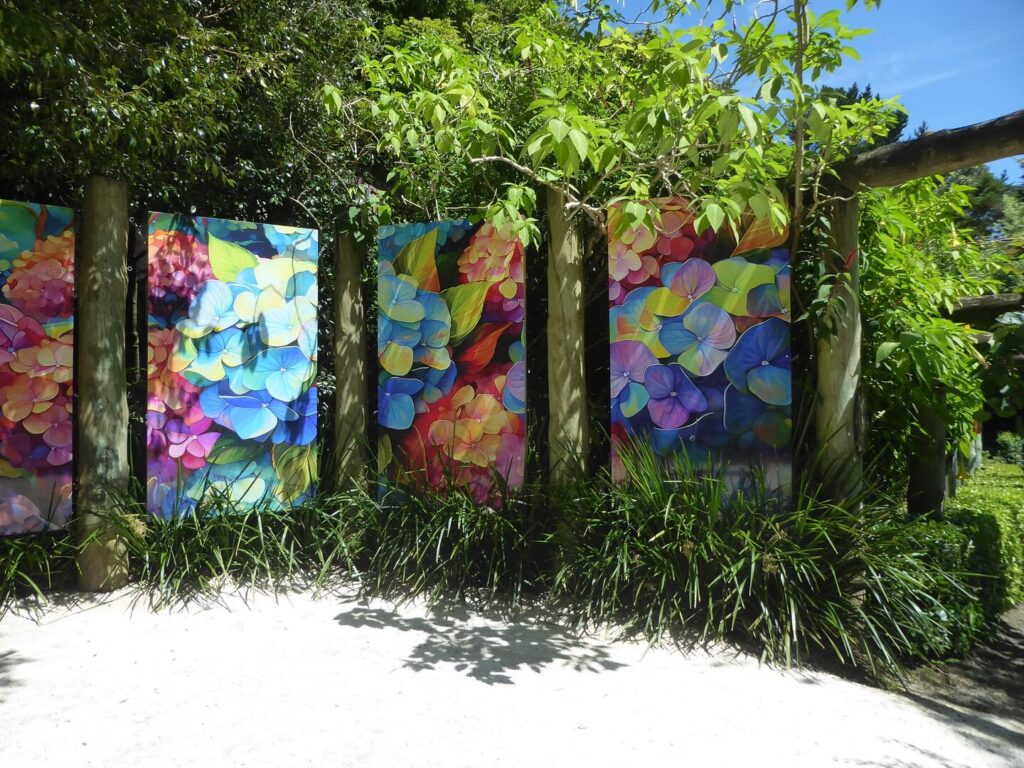
“I don’t normally like to say that I have a favourite sculpture,” she says, however, this year it would be a collection of bright hydrangea panels by Mangawhai artist Sarah C, in an area they call Woodhenge.
“I love colour,” she says. “You can probably tell.”
It’s the same habit that’s shaped almost everything else here: find the least exciting part, and fix it. Once, the property was an empty paddock.
Now it’s a vibrant Plant Centre with a garden made for all ages to explore, all year long.
Business:
Kaipara Coast Plant Centre and Sculpture Gardens
Location:
1481 Kaipara Coast Highway, Kaukapakapa, North West Auckland
Contact:
David and Geraldine Bayly, 09 420 5655
What they do:
An independent nursery and garden centre alongside a public sculpture trail and gardens, with an annual exhibition changeover each November.