

On a recent wander through Kaukapakapa, we decided, almost on a whim, to pull in at a local watering hole, Shed 16. What we found was far more than just a place to eat. This beautifully restored country pub welcomed us with hearty food, good drinks, and the sort of warm, genuine service that makes you want to stay awhile. But it was the walls, lined with stories of the district’s past, that truly captured our attention.
Among them was a striking photograph of workers standing proudly beside a towering stack of harvested harakeke. One familiar local name appeared alongside the image: William Henley of Henley House (positioned second from the right). Thanks to contributions from A. Jordan and Te Awaroa Museum, the image offered a vivid window into a chapter of Kaukapakapa’s history that is easy to overlook today.
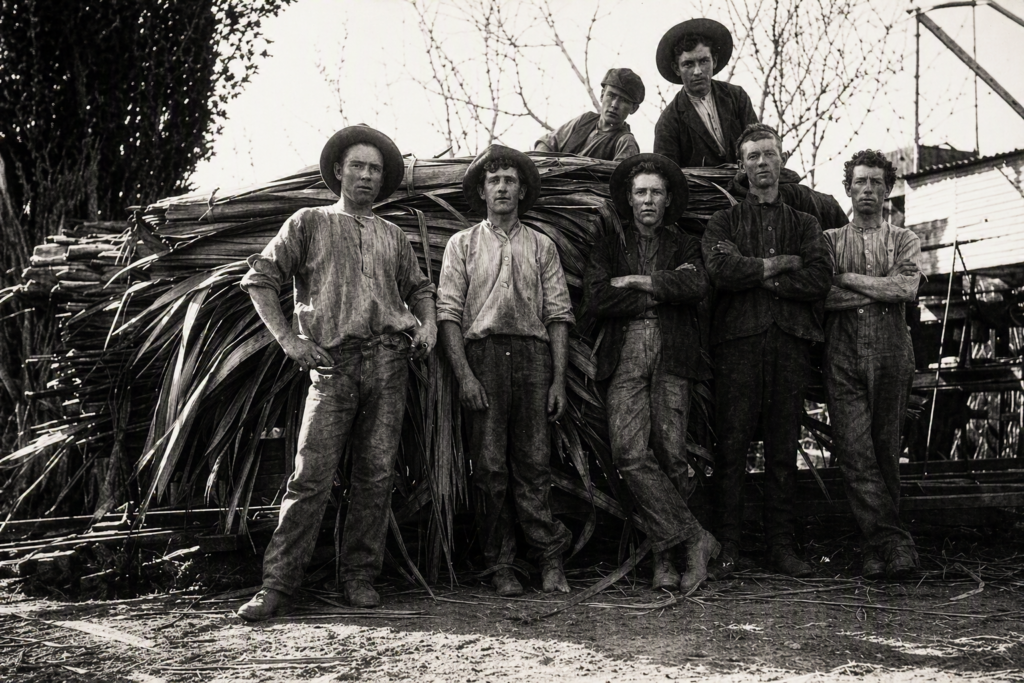
Harakeke, or New Zealand flax, has long been regarded by local iwi as a taonga species, valued not only for its fibre, but also for its medicinal properties. Traditionally, it was used for everything from weaving to treating ailments such as infections and parasites. However, with the arrival of European settlers during the height of international sea travel, harakeke took on a new economic significance. Its strong muka fibres became highly sought after for rope-making, feeding a growing global demand.
In those early days, harvesting flax served a dual purpose. It generated income while helping settlers clear land for agriculture. Sustainability was not a consideration at the time, and as farming expanded, the once-abundant harakeke fields gradually disappeared from the landscape.
Standing there in Shed 16, it was hard not to imagine what the area must have looked like at its peak: vast swathes of flax stretching across the land, and teams of workers cutting, stacking, and preparing it for market. Yet, in a twist that feels both timely and hopeful, harakeke is making a remarkable comeback.
Today, this traditional plant is at the centre of cutting-edge innovation. Companies such as Christchurch-based KiwiFibre are developing advanced composite materials from harakeke, offering sustainable alternatives to carbon fibre and fibreglass. These materials are already being explored for use in products like surfboards, vehicle components, and sporting equipment, bringing together strength, flexibility, and a significantly lower environmental footprint.
At the same time, researchers are pushing the boundaries even further. In laboratories across New Zealand, scientists are investigating how harakeke fibres can be transformed into nano-engineered carbon materials for use in supercapacitors, which are high-performance energy storage devices. It is remarkable to think that a plant once harvested by hand in Kaukapakapa paddocks could now play a role in the future of clean energy technology.
Leaving Shed 16, one lingering thought remained: what might Kaukapakapa look like today had those flax fields endured? The past suggests an industry, the present points to innovation, and perhaps, just perhaps, the future holds an opportunity to reconnect the two.